
 العربية
 Русский
 اردو
اردو
 中文
中文
 Français
Music Licensing in the UAE: Which Establishments Are Included?
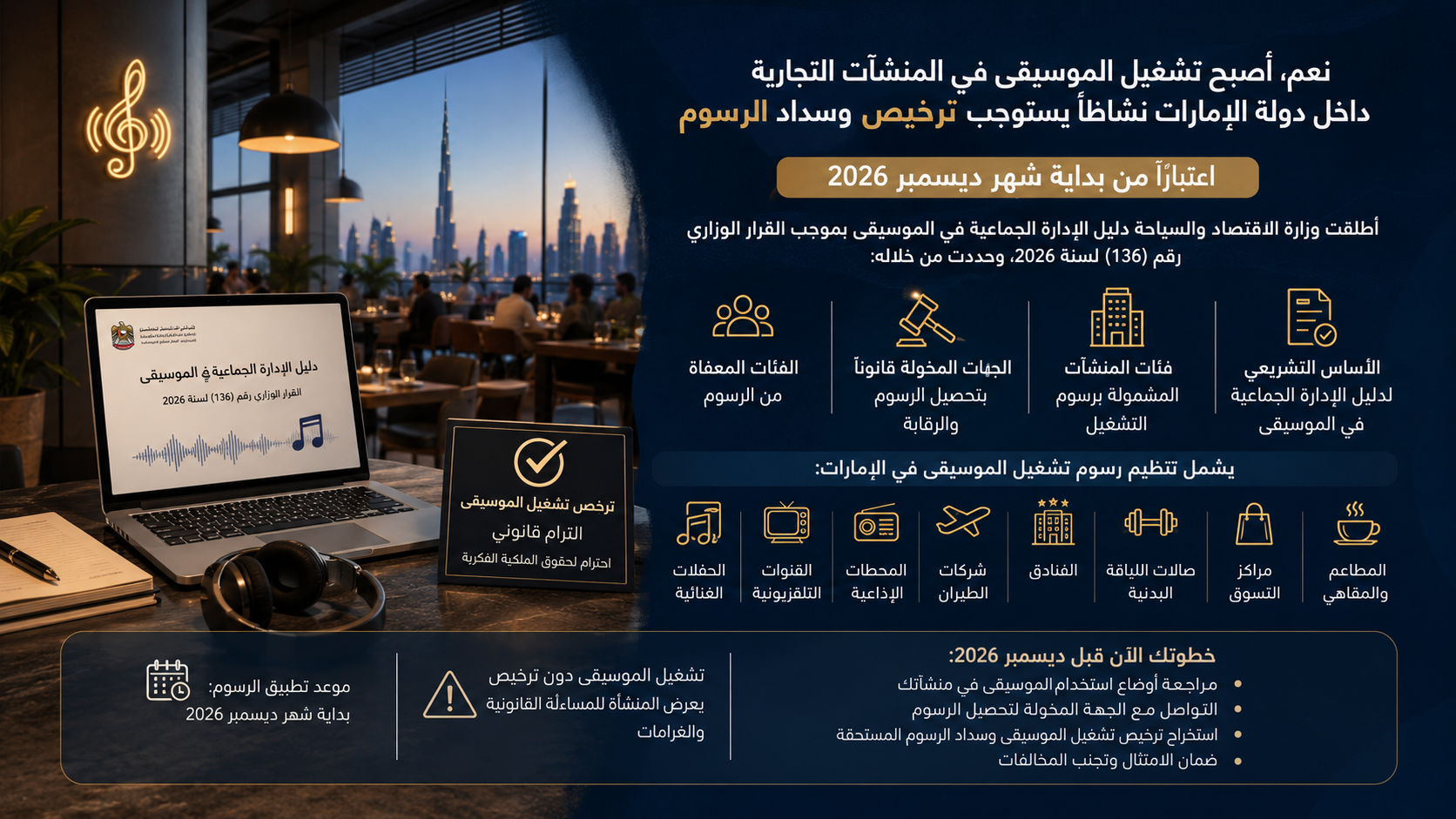
Yes. Playing music in commercial establishments in the United Arab Emirates now requires a music licence and the payment of music licensing fees in the UAE, effective from the beginning of December 2026. The Ministry of Economy and Tourism has launched the Collective Management in Music Guide under Ministerial Decision No. (136) of 2026, setting out the categories of establishments covered by music activity licensing fees in the UAE, the entities legally authorised to collect music licensing fees and administer copyright and neighbouring rights, and the categories exempt from music licensing fees. Every commercial establishment that uses musical works as part of its activity now faces a clearly defined regulatory obligation and should review its legal position before the music licensing fees in the UAE take effect.
The music licensing regime in the UAE covers restaurants and cafés, shopping malls, fitness centres, hotels, airlines, radio stations, television channels and concert organisers, making the music licence a direct compliance matter for a broad segment of commercial establishments across the country.
This article examines music licensing fees in the UAE and how they are tiered, the establishments covered by the music licence, the categories exempt from the fees, the entities legally authorised to collect and supervise, the legislative basis of the Collective Management in Music Guide within the framework of the copyright and neighbouring rights law, the avenues of accountability where music is played without a licence, and the practical steps establishments should take before December 2026.

What is the Collective Management in Music Guide?
The Collective Management in Music Guide is a regulatory instrument issued by the Ministry of Economy and Tourism to organise the local music market and raise public awareness of the framework protecting the rights of authors, creators and music production companies, including composers, songwriters, singers, performers, producers of sound recordings and music publishers.
The Guide facilitates the administration of financial and artistic rights, reduces the scope for infringement of creators' rights, and unifies the standards governing music licensing fees and licensing mechanisms, so as to ensure lawful and fair use of musical works within the country. Its issuance extends the copyright and neighbouring rights regime already in force in the UAE and consolidates an integrated framework for the governance of those rights in line with leading international practice.
The Ministry of Economy and Tourism grants the licence to practise collective management activity in the field of music to the relevant categories of entities and establishments for a period of one year, renewable in accordance with the applicable rules and conditions.
Which establishments are covered by music licensing fees in the UAE?
The Guide identifies the categories of entities and establishments subject to the fees for granting a licence to practise collective management activity in the field of music, given that the use of music in these establishments engages copyright and neighbouring rights. These categories are:
Restaurants and cafés | Shopping malls | Fitness centres | Hotels and floating hotels |
Airlines | Radio stations | Television channels | Concerts and similar events |
The Guide sets tiers for collecting music licensing fees according to the nature of the use and the scale of the economic activity. The fee is therefore not a single flat amount applied to all establishments, but graduated according to the classification of the establishment and the extent of its use of musical works.
Which categories are exempt from music licensing fees?
The Ministry of Economy and Tourism has clarified that a number of uses and categories are exempt from paying music licensing fees, namely:
Educational and academic institutions
Government entities
Uses taking place in the context of national occasions
Celebrations and personal occasions of a non-commercial character
Any other uses or categories the Ministry decides to exempt by a decision issued by it
The criterion for exemption turns on the absence of a commercial character to the use, or on the governmental or educational status of the entity. Establishments should therefore obtain a careful legal assessment of the nature of their use of music before relying on any of these exemptions.
Which entities are legally authorised to collect music licensing fees?
The Ministry has clarified that the collection of music licensing fees and the administration of these rights within the country are carried out through two entities authorised by the Ministry to practise collective management activity in the field of music, namely the Emirates Music Rights Association and Music Nation, including organising the collection and distribution of the rights of music creators.
Whenever regulatory necessity or the public interest so requires, the Ministry may amend any of the conditions, controls or obligations attached to the licence to practise collective management activity in the field of music during its term, and the licensed entity must implement those amendments as soon as they are adopted.
What is the legislative basis for licensing commercial music use?
The regulation of music licensing fees rests on a well-established legislative basis in the UAE. Under the copyright and neighbouring rights law, the author and the neighbouring rights holder enjoy financial and moral rights over the work, including the right of public performance and communication to the public. It follows that exploiting a musical work before the public within a commercial establishment requires written authorisation from the rights holder or from a party lawfully representing them.
This is where the function of the collective management system becomes clear. It is practically impossible for every commercial establishment to negotiate individually with each author, composer or producer of sound recordings. Licensed collective management societies therefore represent rights holders, grant blanket licences to establishments, and collect and distribute the consideration to those entitled to it. This is the model applied internationally, and the Collective Management in Music Guide brings it within a defined framework in the UAE and unifies its standards.
Does a streaming subscription dispense with a music licence?
This is among the points most commonly misunderstood by establishment owners. An individual subscription to a music streaming platform grants the subscriber a personal licence of limited scope for non-commercial listening, and its effect does not extend to public performance inside a commercial venue open to the public. The terms of use of these platforms themselves typically restrict use to personal purposes.
The same logic applies to playing radio or television channels inside the establishment, or to using pre-prepared playlists. What matters is not the source of the music but the act of communicating it to the public in the course of a commercial activity. Establishments should therefore review their existing arrangements for playing music in light of the new licensing requirements.
What are the avenues of accountability where music is played without a licence?
Accountability for infringement of copyright and neighbouring rights is distributed across three avenues provided for within the legislative framework of the country, as follows:
The administrative and regulatory avenue: handled by the Ministry of Economy and Tourism as the authority competent for supervision, inspection and the receipt of complaints, and pursued either by seeking an amicable settlement or by taking the necessary regulatory measures.
The civil avenue: based on the right of the rights holder to resort to the civil courts to claim compensation for moral and material harm, together with the interim measures the law makes available before the judge of urgent matters, including establishing the fact of public performance, halting an ongoing performance or prohibiting it in future, and attaching the revenue generated by it.
The criminal avenue: arises where the elements of the offence of infringing copyright or neighbouring rights provided for in the copyright and neighbouring rights law are established. The legislator has prescribed penalties of imprisonment and a fine, or either of them, while expressly preserving any more severe penalty provided for by another law.
The legislator has also established a committee competent to consider disputes and grievances relating to copyright, with the aim of simplifying procedures and expediting the resolution of disputes before resorting to the courts, while its decisions remain open to challenge before the courts of the country.
The Cultural Support Fund in the field of music
The Guide provides for the establishment of the Cultural Support Fund in the field of music, which aims to provide financial, technical and artistic support in the areas of composition, music production, distribution and live performance, to empower creators and talent, to support the growth of the cultural and music industries, and to strengthen the presence of Emirati music at the regional and international levels.
The Fund is subject to the supervision of the Ministry of Economy and Tourism and is administered through a joint committee comprising representatives of the Ministry of Economy and Tourism and the Ministry of Culture. A share of 10% of the total amounts collected is allocated to funding its programmes and initiatives, with an independent bank account established for the deposit of these allocations and a commitment to transparency in accordance with the approved controls.
Key dates and parameters
2026 Collection of music activity licensing fees begins from the start of December 2026 | 1 The licence runs for one year and is renewable in accordance with the applicable rules and conditions | 10% The share of total amounts collected allocated to funding the Cultural Support Fund |
How should your establishment prepare before December 2026?
Determine whether the regime applies to your activity
Review the classification of your establishment and the extent of its use of musical works in order to determine whether it falls within the categories subject to music licensing fees or within the prescribed exemptions.
Review the licence agreement before signing it
Examine the clauses on term, renewal, the method of calculating the fee, the applicable tier, the limits on access to records, and contractual penalties, before entering into any agreement with the entity authorised to collect.
Identify contractually which party bears the fee
In franchise agreements, hotel management agreements and leases of units within shopping malls, the party bearing the music licensing fee should be expressly identified, since many existing contracts are silent on this point.
Document use and retain supporting records
Keep copies of the licence, payment receipts and usage records, as these are the primary evidence of the establishment's compliance in the event of any review or inspection by the competent authority.
Submit an exemption request where its conditions are met
Where the use is non-commercial in character, connected with a national occasion, or made by an educational or governmental entity, the prescribed exemptions may be relied upon once a complete legal basis has been prepared.
Legal references
Federal Decree-Law No. (38) of 2021 on Copyright and Neighbouring Rights
Cabinet Resolution No. (47) of 2022 on the Implementing Regulation of the Copyright and Neighbouring Rights Law
Ministerial Decision No. (136) of 2026 approving the Collective Management in Music Guide
Berne Convention for the Protection of Literary and Artistic Works
WIPO Performances and Phonograms Treaty
Frequently asked questions about music licensing fees in the UAE

Our services across the Emirates
Dubai
In Dubai, AWADH ALMHEIRI LAW FIRM AND LEGAL CONSULTATIONS provides specialised services relating to music licensing fees, the licence to practise music activity and the Collective Management in Music Guide. These include assessing whether the fees apply to restaurants, cafés, hotels, shopping malls, fitness centres and concert organisers, reviewing licence agreements, preparing exemption requests, and representation in disputes concerning copyright and neighbouring rights.
The other Emirates
Our legal services relating to music licensing and compliance with the Collective Management in Music Guide extend to Abu Dhabi, Sharjah, Ajman, Umm Al Quwain, Ras Al Khaimah and Fujairah, covering hospitality, retail, entertainment, media and events establishments across the country, so that they are fully prepared in legal terms before music licensing fees take effect in December 2026.