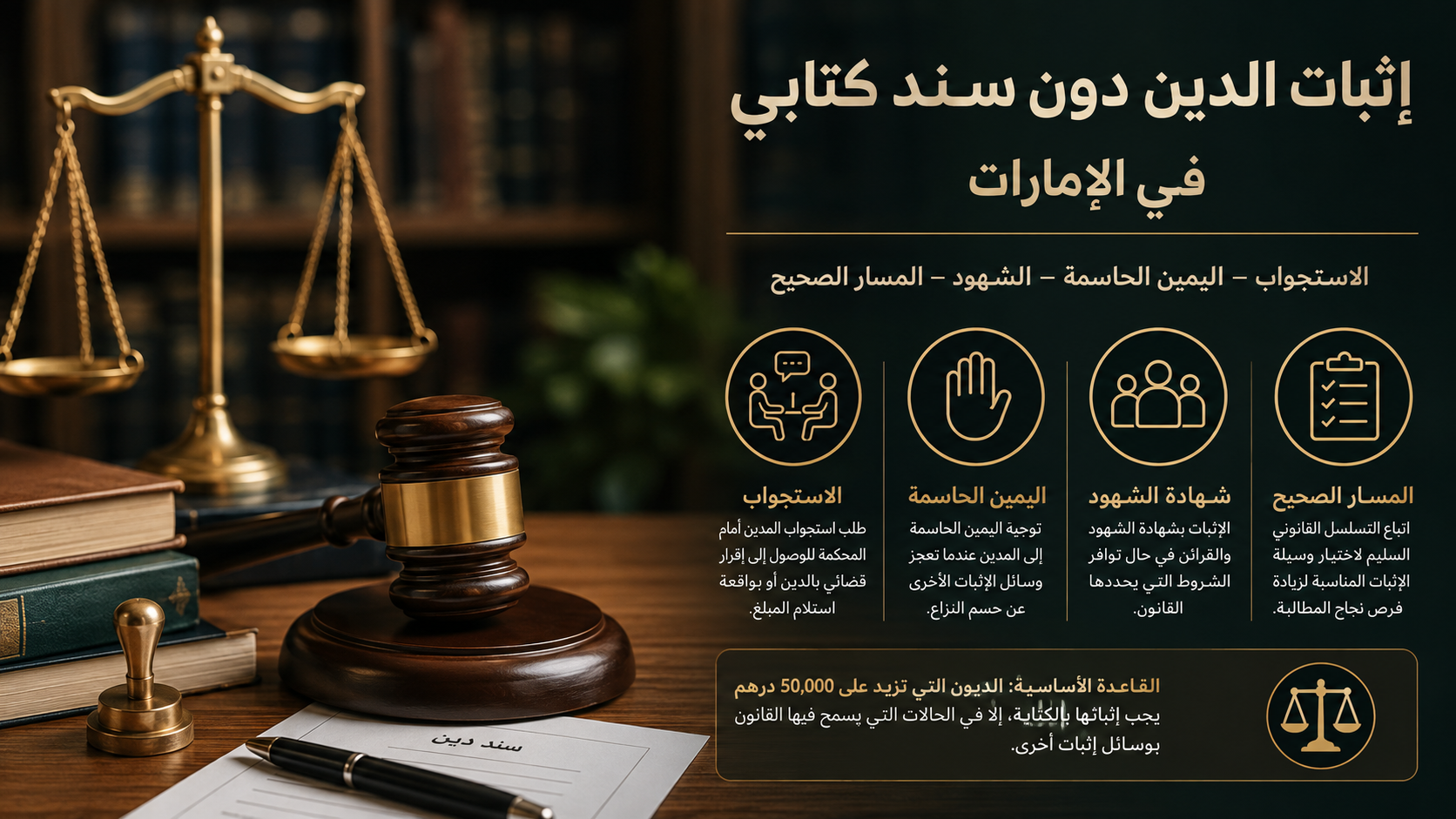
Can a debt be proved without a written instrument in the UAE? Yes — a debt can be proved before the UAE courts even without a contract or a written receipt. Under the Law of Evidence in Civil and Commercial Transactions, the general rule is that any transaction exceeding 50,000 dirhams must be proved in writing; yet the same law gives electronic evidence the force of proof in writing — such as bank transfers and electronic correspondence — and allows a judicial admission, a decisive oath, or a commencement of proof in writing supported by another means of proof to take the place of writing. It also empowers the court, where the debtor fails without acceptable excuse to attend examination, to accept witness testimony and presumptions in cases where they would otherwise be inadmissible. The right question, therefore, is not “do I have a contract?” but: what evidence is available, and in what legal order should it be used?

⚖️Does Every Debt Require a Written Instrument?
The Law of Evidence draws a decisive line: every transaction exceeding 50,000 dirhams, or of undetermined value, must be proved in writing, and witness testimony is inadmissible to prove its existence or extinction. The obligation is assessed by its value at the time the transaction was made, without adding accessories to the principal.
📌An important detail on multiple claims
Where the case comprises multiple claims arising from multiple sources, testimony is admissible for each claim not exceeding 50,000 dirhams, even if those claims together exceed that threshold. This point is frequently overlooked when drafting the claims.
Conversely, testimony is inadmissible even where the value does not exceed 50,000 dirhams in certain cases, including: what the law requires to be in writing for its validity or proof; where the claim is for the balance of a right that may only be proved in writing; what contradicts or exceeds the content of written evidence; and where a party claims more than 50,000 dirhams and then reduces the claim below that figure.
💻Electronic Evidence Has the Force of Writing — Your Strongest Card
This is the most significant development introduced by the Law of Evidence: proof by electronic evidence has the same force as proof in writing. That means an electronic message or a bank transfer may not be a “mere presumption”, but evidence standing on its own where writing is required.
Electronic evidence includes: the electronic record, the electronic document, the electronic signature, the electronic seal, electronic correspondence including e-mail, modern means of communication, and electronic media. Non-official electronic evidence carries the force of a private document, and the burden of proving that it is not authentic falls on the party alleging so.
🔐A practical condition not to be overlooked
Extracts from electronic evidence carry the same force as the evidence itself to the extent that they conform to their electronic record, and the same applies to extracts from electronic payment means. Preserve the digital original, not merely a screenshot; and if you refuse without acceptable excuse to produce what the court requests in order to verify authenticity, you forfeit the right to rely on it.
🔍Examination: The Shortest Route to a Judicial Admission
The court may, of its own motion or upon the request of a party, order the attendance of the opposing party for examination, and the party so ordered must attend the session fixed for that purpose. The value of this step becomes apparent where no contract exists, because the questions bear directly on facts known only to the debtor: did he receive the sum? when? what is the reason for the transfer credited to his account? did he ask for time to pay?
If he admits before the court a legal fact alleged against him during the course of the case, we are before a judicial admission, which under the Law of Evidence is conclusive against the person making it, confined to him, and irrevocable. A claim weak in documentary evidence is thereby transformed into one resting on the strongest means of proof.
⚠️Failure to Attend Examination: The Golden Provision
Where a party fails to attend for examination without acceptable excuse, or attends and refuses to answer without valid justification, the Law of Evidence provides that the court shall draw such inference as it deems fit, and permits it to accept proof by witness testimony and presumptions in cases where these are not admissible.
🎯Why this provision is pivotal to your case
Because it opens the door to testimony and presumptions in a debt exceeding 50,000 dirhams with no written instrument — precisely the situation that would otherwise end at the rule requiring writing. But note: failure to attend is not an automatic admission of the debt; it empowers the court to draw inferences and permits it to accept means that were originally barred.
👥Witness Testimony: When Is It Admitted and When Refused?
The law permits proof by testimony in matters that had to be proved in writing in four cases: where a commencement of proof in writing exists, whether electronic or paper; where a physical or moral impediment prevented obtaining written evidence; where the claimant lost his written instrument for a reason beyond his control; and where the written evidence is challenged as containing what the law prohibits or as contrary to public order or morals.
👨👩👧Moral impediments — and here lies a point in your favour
The law treats the marital bond and the ties of kinship and affinity up to the fourth degree as moral impediments. So where the debt is between relatives, the very absence of a written instrument may itself be a legal justification for admitting testimony.
🚫The most common error in choosing a witness
The testimony of a person who thereby averts harm from himself or secures a benefit is inadmissible, as is the testimony of an ascendant for a descendant, of a descendant for an ascendant, or of one spouse for the other even after their separation. Nor is a person under 15 years of age competent to testify. Testimony must be of what was seen, inspected or heard, and hearsay is admissible only in matters that generally cannot otherwise be known.
📜The Decisive Oath: An Effective — and Dangerous — Weapon
The law expressly provides that, in cases where proof must be in writing, its place may be taken by a judicial admission, a decisive oath, or a commencement of proof in writing supported by another means of proof. The decisive oath is therefore not a supplementary step but a legal substitute for documentary evidence itself.
It may be administered at any stage of the case, provided the fact on which it bears relates to the person to whom it is directed; where the fact is not personal to him, it bears merely on his knowledge of it. The person to whom it is directed may refer it back to his opponent, unless it bears on a fact known to him alone. Neither the party who administered the oath nor the one who referred it back may withdraw once the opponent has agreed to swear.
⚖️A decisive difference between failing to attend examination and failing to swear
Failure to attend examination empowers the court to draw inferences and opens the door to testimony and presumptions. But a person summoned to swear must attend: if he attends and does not contest the admissibility of the oath, he must swear immediately or refer it back, failing which he is deemed to have refused; and if he fails to attend without excuse he is likewise deemed to have refused. The consequence here is sharper and swifter.
Do not confuse the decisive oath with the supplementary oath: the former is administered by a party to his opponent and may be referred back; the latter is administered by the judge of his own motion to complete the evidence, may not be referred back, and requires that the case contain neither complete evidence nor a total absence of evidence.
📂A Neglected Card: Compelling the Opponent to Produce a Document
You may ask the court to compel your opponent to produce any electronic or paper document material to the case that is in his possession, where the law permits it to be demanded, where it is common to both of you, or where your opponent relied on it at any stage. The request must state the description and content of the document, the indications that it is in the opponent's possession, and the fact it is intended to establish.
💥The effect of refusal
If the opponent refuses to produce the document after being given one further opportunity, the copy you submitted is deemed a true copy of the original; and if you submitted no copy, the court may accept your account of the document's form and content. In commercial cases, his refusal is treated as a presumption of the correctness of your allegation. A party failing to deposit documents may also be fined between 1,000 and 10,000 dirhams.
🗺️A Practical Roadmap for Claiming a Debt Without an Instrument
1Collect every digital or financial trace
Bank transfers, electronic correspondence, messages in which the debtor asks for time, electronic payment records — keeping the digital original that conforms to its record, not the screenshot alone.
2Determine the value of the transaction precisely
50,000 dirhams or less: the door to testimony is open as a matter of principle. More than that: look for one of the exceptions or the substitutes that take the place of writing.
3Request the defendant's examination
Particularly on facts known to him alone: the reason for the transfer, the fact of receipt, the promise to repay.
4Put the outcome of the examination to work
A judicial admission is conclusive evidence; a failure to attend without excuse opens the door to testimony and presumptions.
5Choose your witnesses carefully
A witness who personally observed the handing over of the money — not a relative whose testimony the law rejects.
6Consider the decisive oath last
After the other means have been exhausted, and with precise drafting of the fact to be sworn to.
⏱️Key Figures to Remember
Threshold requiring proof in writing
Anything exceeding 50,000 dirhams, or of undetermined value
Threshold at which testimony is admissible as of right
50,000 dirhams or less
Age of competence to testify
15 years — statements below that age are heard for guidance only
Moral impediments to obtaining written evidence
Marriage, and kinship and affinity up to the fourth degree
Fine for failing to deposit documents
From 1,000 to 10,000 dirhams
📚Legal References
The Law of Evidence in Civil and Commercial Transactions issued by Federal Decree-Law No. (35) of 2022
Federal Decree-Law
Federal Decree-Law No. (46) of 2021 on Electronic Transactions and Trust Services
Federal Decree-Law
The Civil Transactions Law issued by Federal Law No. (5) of 1985, as amended
Federal Law
Has your debtor denied the debt while you hold no written instrument?
AWADH ALMHEIRI LAW FIRM AND LEGAL CONSULTATIONS examines your electronic and financial evidence, prepares applications for examination and for compelling the opponent to produce documents, drafts the decisive oath, and files the debt claim before the courts of the State.
Assess your prospects before filing
❓Frequently Asked Questions
QCan a debt be proved without a written contract in the UAE?
Yes. The absence of a contract does not mean the right is lost. Electronic evidence has the force of proof in writing, and a judicial admission, a decisive oath, or a commencement of proof in writing supported by another means of proof may take the place of writing.
QWhat is the threshold at which proof in writing is required?
Every transaction exceeding 50,000 dirhams, or of undetermined value, must be proved in writing, and witness testimony is inadmissible to prove its existence or extinction.
QAre electronic correspondence and bank transfers admissible evidence?
Yes. Electronic correspondence, records and media are forms of electronic evidence, and extracts from them carry the same force as the evidence itself to the extent that they conform to their electronic record — which also applies to extracts from electronic payment means.
QWhat if the debtor refuses to attend for examination?
If he fails to attend without acceptable excuse, or refuses to answer without valid justification, the court draws such inference as it deems fit and may accept proof by testimony and presumptions in cases where these are not admissible. It is not, however, an automatic admission of the debt.
QIs the testimony of my brother or my wife admissible on the debt?
The testimony of an ascendant for a descendant, of a descendant for an ascendant, or of one spouse for the other even after separation is inadmissible, as is that of a person securing a benefit or averting harm for himself. That said, the tie of kinship may constitute a moral impediment justifying the admission of testimony from others.
QWhat is the difference between refusing the oath and failing to attend examination?
A person summoned to swear who does not contest the admissibility of the oath must swear immediately or refer it back, failing which he is deemed to have refused; and failing to attend without excuse likewise amounts to refusal. Failure to attend examination, by contrast, is not an admission: it empowers the court to draw inferences and to accept testimony and presumptions.

Legal Disclaimer
The information contained in this article is provided for legal awareness and community education purposes only. It does not constitute legal advice and does not create an attorney-client relationship. Outcomes differ according to the facts and documents of each case and the legislation in force at the time it is heard, and subsequent amendments may be made to the texts referred to. Specialised legal advice should be obtained before taking any action. In the event of any discrepancy, the Arabic text of this article is the authoritative reference.
Our Legal Services in Dubai
AWADH ALMHEIRI LAW FIRM AND LEGAL CONSULTATIONS in Dubai provides services in debt claims and their proof, payment order applications, applications for examination, for the decisive oath and for compelling the opponent to produce documents, and advocacy before the Dubai courts at all levels. The firm is located on Oud Metha Street, Ibrahim Khalil Al Sayyegh Building, Office 101, Dubai.
Our Services Across the Other Emirates
We also provide our services in Abu Dhabi, Sharjah, Ajman, Umm Al Quwain, Ras Al Khaimah and Fujairah, including debt claims, the analysis of electronic evidence, and the preparation of evidentiary memoranda before the federal and local courts.

 العربية
 Русский
 اردو
اردو
 中文
中文
 Français