
 العربية
 Русский
 اردو
اردو
 中文
中文
 Français
Guide to Arbitration Procedures for Major Corporate Disputes
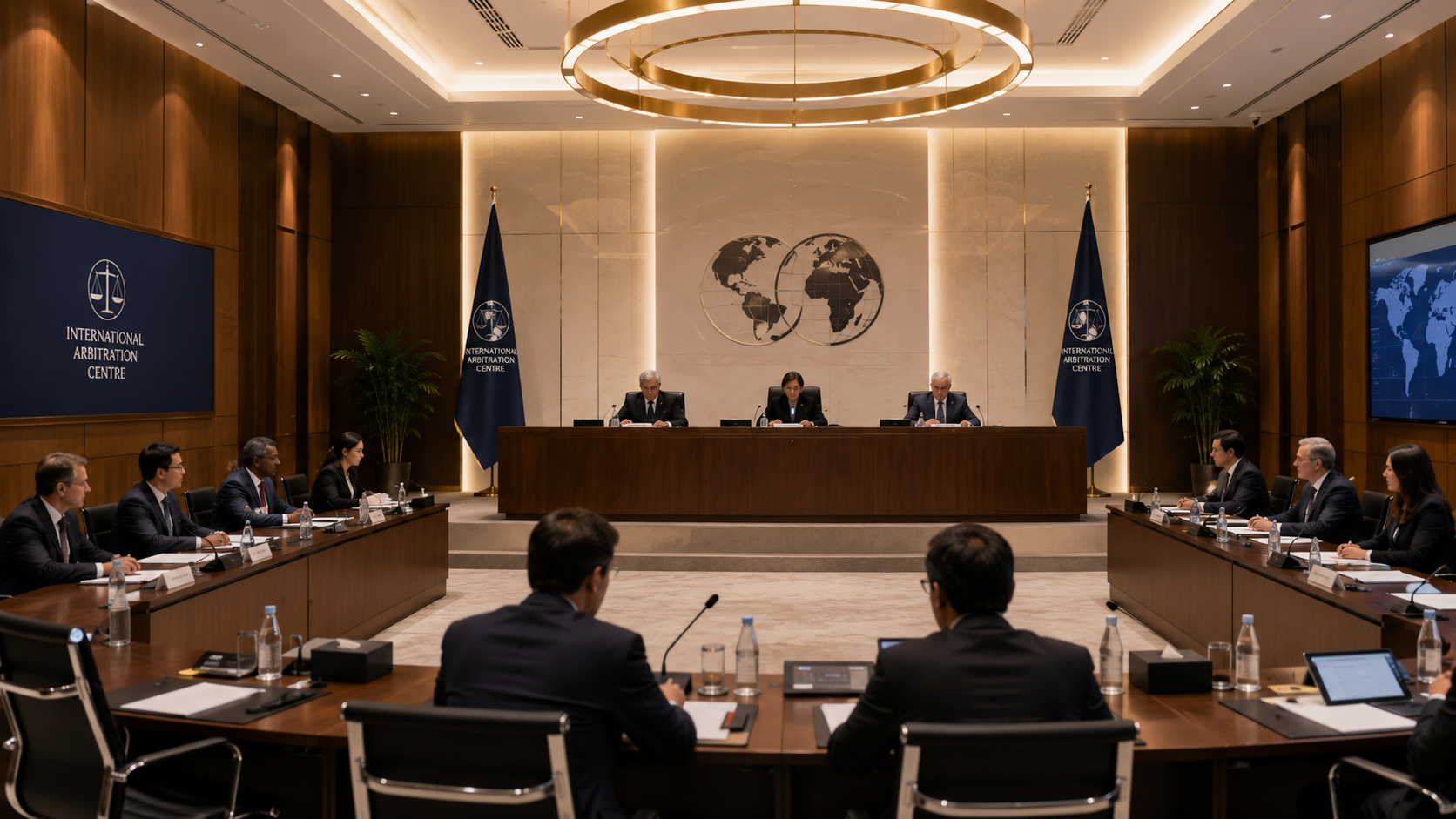
Major companies and institutions in the United Arab Emirates resort to arbitration as a flexible and effective means of resolving their commercial and investment disputes away from traditional litigation, owing to the confidentiality, speed, and specialised expertise it offers in settling high-value disputes of a complex technical nature. The UAE legislator has established a modern legislative framework that regulates arbitration proceedings from their commencement through to the enforcement of the award, granting the parties to major disputes confidence in the fairness of the proceedings and the enforceability of the resulting awards.
How Do Arbitration Proceedings for Resolving Major Disputes Work in the United Arab Emirates?
First: The Concept of Arbitration and When It Is Resorted To for Resolving Major Disputes
Arbitration is an alternative means of resolving disputes whereby the parties agree to submit their disagreement to an arbitral tribunal that renders a binding award instead of resorting to the courts. Arbitration in the State is governed by the Federal Arbitration Law and its amendments, which apply to every arbitration conducted within the State unless the parties agree to subject it to another law, and to any arbitration whose parties agree to subject it to its provisions. The role of arbitration stands out in major disputes for the possibility it affords of selecting arbitrators with technical expertise in the subject matter of the dispute, the confidentiality that protects business secrets, and proceedings that are more flexible than litigation.
Confidentiality
Arbitration hearings are held away from publicity, protecting the business secrets and commercial standing of the parties.
Specialised Expertise
It allows the selection of arbitrators with technical knowledge of the subject matter, as required by complex major cases.
Enforceability
Arbitration produces a binding award capable of ratification and enforcement within the State and abroad under international conventions.
Second: The Arbitration Agreement as the Basis of the Proceedings
Arbitration arises only by a written agreement between the parties, whether in the form of a clause within the original contract before the dispute arises, or as a separate submission agreement concluded after it. The law requires that the arbitration agreement be made by a person who has the capacity and standing to dispose of the right in dispute, and that it be in writing, failing which it is void. The arbitration agreement is treated as independent of the original contract, so the nullity, rescission, or termination of the contract does not affect the validity of the arbitration clause as long as the agreement is itself valid — granting the arbitration proceedings stability against attempts to evade them.
Third: Commencing Arbitration Proceedings and Filing the Request for Arbitration
Arbitration proceedings commence — unless the parties agree otherwise — on the day following the respondent's receipt of the request for arbitration. The request includes the particulars of the parties, the subject matter of the dispute, its basis in the arbitration agreement, and the claimant's claims. In institutional arbitration, proceedings are filed in accordance with the rules of the agreed arbitration centre, including the Dubai International Arbitration Centre, which was reorganised to be the principal centre in the Emirate of Dubai, while ad-hoc arbitration is conducted according to the rules agreed upon by the parties, all subject to the provisions of the Federal Arbitration Law as the governing framework.
Fourth: Constituting the Arbitral Tribunal and Selecting the Arbitrators
The arbitral tribunal is composed of one or more arbitrators, and their number must be odd, failing which the arbitration is void. The parties are free to agree on the number of arbitrators and the manner of their selection; if they do not agree, the competent authority or the arbitration centre appoints them. An arbitrator must have no interest in the dispute and must be impartial and independent. The recent amendments to the Arbitration Law have reinforced the controls relating to the requirements of the arbitrator and their relationship with the parties so as to ensure their integrity. An arbitrator must disclose any circumstances that give rise to doubts about their impartiality, and may be challenged where serious grounds affecting their independence exist.
Fifth: The Conduct of Proceedings and the Exchange of Memoranda and Evidence
Arbitration proceedings are conducted in accordance with what the parties agree, while observing the principle of equality between them and enabling each to present its case and defence. The claimant submits its memorandum setting out the facts of the case, its claims, and their supporting grounds, and the respondent replies with its defence and any counterclaims it may raise. Documents and evidence are exchanged, testimony is heard, and expert opinion is appointed where appropriate. The arbitral tribunal has discretion to assess the evidence and to determine the applicable rules of evidence in a manner not contrary to public policy. Hearings may be held in person or by means of modern technology, and the arbitration may be conducted in a language agreed upon by the parties.
Sixth: Interim and Conservatory Measures During Arbitration
The law empowers the arbitral tribunal — unless the parties agree otherwise — to order interim or conservatory measures required by the nature of the dispute, such as preserving evidence or the funds in dispute, or preventing a measure that may cause irreparable harm. Recourse may also be had to the competent court to obtain such measures before or during the arbitration without this being deemed a waiver of the arbitration agreement. In major disputes, these measures afford urgent protection to the parties' positions pending the award that finally determines the merits.
A key point: The precise drafting of the arbitration clause in the contract — in terms of specifying the centre, the rules, the seat of arbitration, its language, and the number of arbitrators — spares the parties procedural disputes that may obstruct the proceedings in major disputes. For this reason, reviewing contracts at the time of their conclusion is among the most important safeguards for the soundness of the arbitration later.
Seventh: Rendering the Arbitral Award and the Conditions for Its Validity
The arbitral tribunal renders its award by a majority of opinions, and it must be in writing, signed, reasoned, and contain the particulars of the parties, a summary of the arbitration agreement, the claims, the operative part of the award, and the date and place of its issuance. The award is rendered within the period specified by law, namely six months from the date of the first hearing, unless the parties agree on a longer period or it is extended in accordance with the law. The arbitral award is final and binding on the parties and carries the authority of res judicata, and it may be challenged only by way of an action for annulment in the cases exhaustively specified by law.
Eighth: Ratification, Enforcement, and Challenge by Annulment of the Award
An arbitral award is not enforced compulsorily until it has been ratified and an enforcement order issued by the competent court, which verifies that it satisfies its formal conditions and does not contravene public policy and morals in the State. The party against whom the award is rendered may seek its annulment before the competent Court of Appeal in the cases exhaustively specified by law, such as the absence or nullity of the arbitration agreement, the incapacity of one of the parties, the impairment of the right of defence, the tribunal ruling on matters outside the arbitration agreement, or the constitution of the tribunal or the proceedings contravening the law or the parties' agreement. Foreign arbitral awards are enforced in the State in accordance with the international conventions in force, including the 1958 New York Convention on the Recognition and Enforcement of Foreign Arbitral Awards.
The Advantages of Arbitration in Resolving Major Disputes
Frequently Asked Questions
To discuss your dispute, assess the suitability of arbitration for resolving it, and develop the appropriate strategy for managing it from commencement to enforcement of the award, the team at AWADH ALMHEIRI LAW FIRM AND LEGAL CONSULTATIONS will be pleased to provide specialised advice tailored to the nature of your case.
Legal References
• Federal Law No. (6) of 2018 on Arbitration.
• Federal Decree-Law No. (15) of 2023 Amending Certain Provisions of Federal Law No. (6) of 2018 on Arbitration.
• Decree No. (34) of 2021 concerning the Dubai International Arbitration Centre.
• The 1958 New York Convention on the Recognition and Enforcement of Foreign Arbitral Awards (to which the State is a party).
The Firm's Services Across the Emirates
Company owners in the Emirate of Dubai search for the best lawyer in Dubai for arbitration and the resolution of major disputes, and for a commercial-cases lawyer and a corporate lawyer to manage arbitral proceedings and draft arbitration clauses in contracts. Many also seek legal consultations for companies in Dubai and services of contract review, debt collection, and commercial and real-estate cases; AWADH ALMHEIRI LAW FIRM AND LEGAL CONSULTATIONS provides a law firm in Dubai that supports the representation of enterprises in domestic and international arbitration and the protection of their interests.
Alongside Dubai, arbitration and dispute-resolution services extend to the rest of the Emirates; company owners find the best lawyer in Abu Dhabi, Sharjah, Ajman, Umm Al Quwain, Ras Al Khaimah, and Fujairah, whether they need a corporate and commercial-cases lawyer, legal consultations and the drafting and review of contracts and arbitration clauses, or representation in arbitral proceedings, debt collection, and real-estate and labour cases. AWADH ALMHEIRI LAW FIRM AND LEGAL CONSULTATIONS provides a law firm across the various Emirates that supports the stability of enterprises' businesses and the protection of their rights.